The Masking of Black Boys: What a Decade Working with Black Boys Labeled "Emotionally Disabled" Taught Me

Updated: May 28
By Dr. Byron M. McClure
Content warning: This piece discusses youth suicide and child trauma.

"How come don't nobody want me, man?"
A few years back, I had a 15-year-old on my caseload. I'll call him D. One morning, D had a run-in with a staff member, and when the bell rang, I saw him in the hallway, visibly upset and growing more agitated. My office was a few feet away, so I got him to step in.
Others could see D in this agitated state and might describe it as rage. Handled wrong, that read gets the cops involved. From the months we had been working together, I knew exactly what was happening with him. I looked at him and said, "I know, man. It's okay, man."
A few seconds of silence went by, and then he broke down sobbing in my arms.
"How come don't nobody want me, man?"

It is a moment I will never forget. This 15-year-old kid sobbed in my arms. It was the unveiling of a mask he had been wearing, a mask that hides pain, hurt, and trauma because the world does not allow Black boys to be vulnerable, soft, or emotional.
D was on an IEP, and his disability category was Emotional Disability. The irony of that label is hard to miss. In a world where Black boys are not allowed to be emotional, the mask goes on.
The mask creates a false perception that these boys are men when they are not, criminals when they are not, while the surface behaviors hide a child who craves structure, love, and the room to be a kid.
Recently, NPR shared a piece by Laurie Stern about kids who have been identified with an Emotional Disability. She followed a Minnesota student named Walter, who has spent years in self-contained Emotional Behavioral Disability (EBD) classrooms, and she got the heart of it right. The ED label is subjective, it sticks, and it lands disproportionately on Black boys and those from historically marginalized communities.
The piece is a great starting point for the conversation.
The NPR piece resonated with me, a Black man and a School Psychologist who practiced across elementary, middle, high, and alternative settings in the DMV for well over a decade, in suburban, rural, and urban districts. I want to add what I learned from my experiences as a Black male School Psychologist to that conversation.
The ED Label, By Design
Under federal special education law, Emotional Disturbance is defined by five criteria.

To qualify, a student must show one or more of the following over a long period of time and to a marked degree, and the condition must adversely affect his educational performance:
an inability to learn that cannot be explained by intellectual, sensory, or health factors
an inability to build or maintain satisfactory interpersonal relationships with peers and teachers
inappropriate types of behavior or feelings under normal circumstances
a general pervasive mood of unhappiness or depression
a tendency to develop physical symptoms or fears associated with personal or school problems
The federal regulation does not define "a long period of time" or "a marked degree."
The name on the label also shifts depending on where you practice. The federal language is Emotional Disturbance. I practiced where it was called Emotional Disability.
Other states and districts call it Emotional Behavioral Disorder, or EBD.
But who decides who gets identified as ED? What those people already believe about the child sitting in front of them.
Who Makes the Decision
ED is an eligibility decision that should be made by the IEP team based on educational impact. Black students are about twice as likely as their peers to be identified with emotional disturbance, per Child Trends' analysis of federal IDEA data, and the U.S. Department of Education has named 786 school districts where Black students were classified with ED at rates at least three times higher than all other students for three consecutive years running.
As a Black male School Psychologist who has sat in those eligibility meetings across more than a decade, I have seen the process and patterns up close, and here’s what I know…
Is it truly an IEP team decision?? I like to think so. What is also true, in many instances, the person steering that eligibility decision is almost always a School Psychologist, and the School Psychologist's lens, training, and cultural understanding are paramount.

A well-trained practitioner knows how to tease apart trauma, social maladjustment, and an actual emotional disability.
Going a step deeper, that same practitioner knows when a behavior is a skill gap and when it is a symptom, and knows what surrounding supports the student will need across tiered levels of support.
The stakes are real at every decision point. Some Black boys do meet the federal criteria for ED, and others do not. Both calls require the deep expertise I mentioned above and carry real consequences.
I have advocated for years against over-identifying Black boys as ED. Identifying a boy who is not truly ED locks him into the most restrictive placements, attaches a label that follows him through every transition, and routes him toward outcomes the data has been warning us about for decades.
The opposite mistake is just as costly. Saying a Black boy does not need services when he actually does pulls services out of reach from the kids who need them most, and leaves them to carry on their own, what no child should have to carry alone.
The clinician's job is to know the difference and to ensure the identification is accurate, the interventions are evidence-based, and the goals are attainable so that a student with this designation can learn and grow, because with the right supports, that student can find their version of success.
From the Hallway to the Crisis Room
Black boys are nearly twice as likely as their White counterparts to receive an out-of-school suspension or expulsion. Black students are 15 percent of K-12 enrollment and 22 percent of students subjected to school-related arrests. They are overrepresented in restraint and seclusion incidents and in alternative school placements.
For too many Black families, the first interaction with the mental health system happens under duress or in the middle of a crisis.
Less than half of African American youth with severe mental disorders receive psychiatric care, and when they do, it often happens in the Emergency Room.
The problem I am highlighting is this… The response to a Black child in crisis is often the police, an emergency room visit, or both. Behavior that gets read as a panic attack in one neighborhood gets read as a public safety threat in another. Behavior that gets read is a boy just being a boy in one setting, gets labeled as defiance or disrespect in another.
When a child is in crisis, and they don’t have the skillset to manage, or others don’t see it as a crisis, or they are forced to hide behind a mask, the outcomes can be tragic.
The first student death I experienced as a practitioner was a sixth grader, a Black male, who died by suicide. I was early in my career, and it ran counter to everything I had been taught and, honestly, what I had been conditioned to believe.
The suicide rate for Black youth ages 10 to 17 rose 144 percent between 2007 and 2020. The Congressional Black Caucus called it "Ring the Alarm" in 2019. Johns Hopkins called it "Still Ringing the Alarm" in 2023. I am suggesting we “Ring The Alarm Louder”. Here’s why…
Black male youth ages five to eleven die by suicide at higher rates than White peers.
What we do not talk about enough is the way pain travels in a Black boy's body when no one has taught him another route.
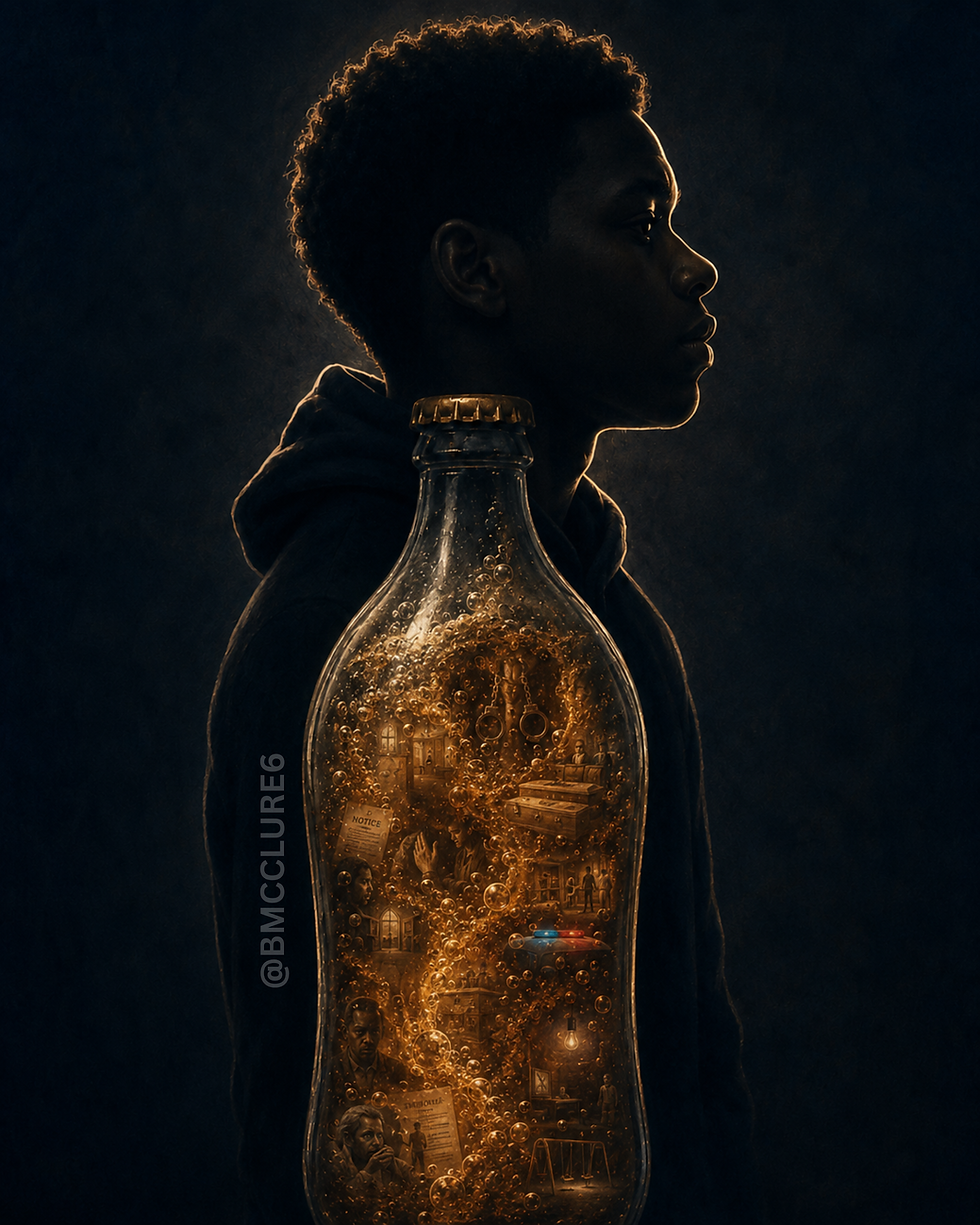
The hurt does not stay inside. It pours out. A good bit of the time I spent with the boys was teaching them coping strategies, healthy ways to release the tension that was already building. I had to explain what was happening to them and why.
Here is how I described it to them. The tension bottled up inside them for years needs somewhere to go, and it sits there like a shaken soda can. Eventually, it has to explode.
The explosion looks like misbehavior, and the misbehavior gets read as a discipline problem before anyone reads it as a mental health issue.
That is part of why African American male youth are three times more likely to be suspended than their White male counterparts. It is also why the mask has to come off. Our boys are hurting, we keep missing it, and the pathway from missing it is crisis or worse.
That is the engine of D's story and the story of many of the boys I sat with who carried this label. A Black boy in pain may be more likely to externalize the pain (don’t get it confused, it’s internalized pain too, and it shows up in externalizing behaviors).
The school reads the behavior as disruptive, defiant, or disrespectful (all subjective), and then the discipline referrals pile up. The IEP team finds the student eligible under ED and in some instances, placed in more restrictive settings. Some would call this modern-day segregation. The label stays with the student and is hard to ever shake.
Underneath all of it is a soda can the world has been shaking for too long, and a child who has been telling us the whole time that he does not think anybody wants him.
What I Learned From the Boys
Here is what I learned sitting with boys like D across elementary, middle, high, and alternative settings.
These kids were not who their files said they were. The boys I worked with were charismatic, funny, smart, and often natural leaders. You could pinpoint, almost down to a school year, when life circumstances cracked them open. The question I learned to ask was what had happened to him and what skills he needed to handle it.
Misbehavior is often masked. When you see defiance, disrespect, and belligerent behavior, those things might be true on the surface. Underneath, there is almost always something a child has not been able to say out loud yet. A Black boy is not given much room in this country to be sad, scared, abandoned, or grieving, so he learns to translate those feelings into a posture that keeps him safe. The label collects around the posture, not the child. What looked like rage in the hallway that day was pain that D had been carrying, finally too heavy to keep holding.
Explicit skill teaching works. The boys I worked with were almost universally into sports, so I built the skill conversation around sports language. If you cannot dribble with your left hand, the answer is repetition with intention: slow practice, pressure drills, contact drills, the same move a hundred times until your body knows it. We took the same approach to self-awareness, self-management, social awareness, relationship skills, and responsible decision-making.

In SWAG, the program I built at a middle school in Southern Maryland, we used the Strong Kids curriculum, made the lessons culturally relevant by using case studies from ESPN's 30 for 30 series, and ran the work through the SAFE framework.
Programs that actually produce better outcomes for students are the ones that are Sequenced, Active, Focused, and Explicit.
Also, I will scream this every chance I get. Conflict resolution might be the single most underrated skill in school, and teaching it directly is hours well spent.
The boys wanted discipline. One of my seventh graders said it best: "We want discipline before the world has to discipline us." Similarly, when I visited the Youth Services Center in DC, the same theme came up. They were asking for structure. They had not gotten enough of it, and they could feel the absence.
Goals have to be tangible, short-term, and theirs. Some of my boys did not think they would live past a certain age, so asking them to think ten years out was not the best approach out of the gate. We had to build to that point and shift the mindset first, which meant starting with what they wanted in the short term and what skill they needed to build to get there. Once they experienced a few small wins, the longer horizon stopped looking impossible. I can not stress how important getting them to a win was. If you don’t do anything else, do this and celebrate that win. Hype them up!
Our mantra in SWAG was simple: we set goals and we achieve them. The cousin to that mantra was progress over perfection. I would ask “are you a bit better today than you were yesterday? If yes, let’s keep putting the work in. If no, we would unpack it and get to why. Either way, work is happening, and that is what matters. Progress over perfection.
Growth has to be measured by data, not vibes. We used Check-In-Check-Out, daily behavior-tracking sheets, and weekly progress reports. We examined disciplinary infractions and wanted to see reductions. By looking at their progress reports weekly we had better intel and insight into what was happening academically and could intervene early and get support.
Early, Proactive Therapeutic Support at Every Tier. Proactive intervention and therapeutic support matter, and the tier at which you intervene changes the outcome.
Tier 1 is where the work starts. Strong classroom relationships, clear expectations, classroom norms and values, and solid instruction are foundational to building social and emotional skills. This is where I encourage practitioners to work with staff and school leaders to prioritize building a safe and supportive culture and climate at the school level. If tier 1 is off, then it will be an uphill battle.
Tier 2 social skills and behavior groups give boys a place to use their voice, practice what they want to say, get feedback from peers, and learn that they are not the only ones in the room carrying their set of stories. Some might even begin doing FBAs and BIPs at this level.
Tier 3 individual counseling, written into the IEP, is where the more intensive support lives for students who need it. Counseling and skill-building before a crisis is a different conversation than counseling after one. The earlier the support shows up in a boy's life, the less the system has to do later.
Strengths have to be named. Every boy in my behavior groups, and even those in individual counseling, took the VIA Character Strengths Survey. We talked about their top strengths in individual sessions, and we looked for moments when those strengths showed up in their daily lives. Naming what was strong gave the boys a place to stand when the hard parts of their lives caught up with them in school.

Representation does the work, the research keeps confirming. Black students who had at least one Black teacher in grades K through 3 were 13 percent more likely to graduate from high school and 19 percent more likely to enroll in college.
For economically disadvantaged Black boys, the same exposure cut the dropout rate by 39 percent. Black teachers hold expectations for Black students that run 30 to 40 percent higher than their non-Black colleagues, and the boys internalize those expectations.
No single practitioner can do this work alone, which is why finding strong community partners and mentors is key. My good brother Rob King was that partner with me.

His work is an open window into the challenges, dangers, and consequences our youth face today, and the message he carries to the boys is real, authentic, and delivered through stories they can touch and feel.
Partners like Rob also build capacity in a system where most practitioners are already stretched thin.
Early intervention is the single biggest variable. Here’s a very hard truth. The boys I worked with starting in first grade had a better shot than the boys I met for the first time in ninth grade.
The older boys were not beyond help, but by the time you meet a boy in ninth or tenth grade, the system has had more time to harden around him, and the lift is heavier.
I believe proactive and early intervention is pivotal. Get the explicit skill teaching, counseling, mentoring, and goal setting in place early, and the high school years will look very different.
Quick Tips for Practitioners Working With Black Boys Identified With ED
If you are a practitioner reading this, here are quick tips you can save, print, and start tomorrow.
1. Talk to the kid. Before you form an opinion, especially from people who have already formed theirs from a place of limitation and bias, here is my challenge to you.
Sit with them, listen, ask what is going on, and believe what the kid tells you. Ask about their school experience, what has worked well for them, and who he thinks is in their corner. Then ask, "How can I best support you?" That question is a major key, and I want you to try it.
Most of the boys I worked with had never been asked any of this. A few important caveats:
Do not interrogate them. Sadly, the boys I worked with were used to being questioned from a place of interrogation, or from the assumption that they did something wrong. Be curious about them instead.
Break bread with them. Ask your admin for a stipend for food or Uber Eats. Your first conversation can happen over lunch. A simple "yo, you hungry?” or “what's your favorite meal on Uber eats?" goes a long way.
Get out of the way and genuinely listen.
Trust takes time. You have to open the door and get started. Failure today is not failure tomorrow. You might not get far on the first try, and he may not want to talk to you yet. You might even get cussed out. Stay persistent and real, and he will see you and know you are there for him.
Be authentically you. They can spot phony from a hallway away.
2. Pull your office discipline referrals for the last quarter and sort by infraction type, with the subjective categories first: defiance, disrespect, and disruption. Use this data to help you build a holistic picture.
These are important points in time, not the full story, and your clinical expertise is what fills in the gaps.
Understand the disciplinary infractions. What is the who, what, when, where, and why of each one?
Look for trends. Is there a particular time of day when referrals happen? If referrals cluster early in the morning, ask why. The kid may be missing breakfast, taking care of siblings before school, or walking into the building already overwhelmed. Be curious and explore.
Follow up with staff for more insight. If a student has 75 percent of his referrals with one teacher, have you spoken to that teacher to get more intel on what is happening in that room?
3. Calculate disproportionality rates. Create the time and space to examine and address disproportionate discipline practices by pulling your ED identification rates and your ODR data by race over the last three years and calculating risk indices and risk ratios for each group. Boneshefski and Runge's (who was part of my dissertation committee) 2014 paper in the Journal of Positive Behavior Interventions walks through the math step by step. Bring the numbers and a concrete question to your leadership. Be curious and explore. Your role is to use these trends to help build a holistic picture of what is happening in the building.
4. Incorporate the SAFE framework into your work. Sequenced, Active, Focused, Explicit. Sequenced means the skills build on each other in a planned order, so a boy learns self-awareness before you ask him to manage conflict. Active means he is doing the skill, not listening to a lecture about it, through role-play, group practice, and real situations from his week. Focused means you carve out protected time to teach the skill on purpose, the way you would teach a math standard. Explicit means you name the skill, define it, and model it, instead of expecting him to absorb it from the air. Run this work for at least 8 weeks before you decide whether it is working, and let the data tell you.
5. Use VIA character strengths with a small group. It is free, and most kids have never been asked what they are good at.
6. Set short, student-owned goals. Track weekly using simple data, and share it with the student.
7. Identify a staff member, community partner, or mentor to walk alongside the work. If you do not have one in the building, look outside the building. Take this a step further: if you have built a Behavioral Intervention Plan for the student, identify a dream team for him. Pull from what he told you about who is in his corner. One boy's dream team might be a coach, a favorite teacher, and a counselor. Others might be a school psychologist, his science teacher, a church mentor, and a member of the varsity team. When an incident comes up, you already know who on that dream team can help.
8. Ask what training and support are needed to better support the student. Most teams jump straight to placement decisions without naming the gap in adult capacity that put the student there in the first place. Make a short list with your team: what does the teacher need, what does the family need, what do you need, what does the student need. Bring that list to leadership as a request for resources, not as a critique of the people in the room.
Mask Off: Where We Go From Here
The mask is the irony of this whole ED label. We label a Black boy as emotionally disabled while operating inside a system that has never given boys like D permission to be emotional in the first place. The mask is what gets read as defiance. The mask is what gets coded as disrespect. The mask is what warrants the IEP and then follows the student relentlessly, telling a half-baked story that the system treats as the whole truth.
The most important lesson I learned from a decade working with boys carrying this label is that they are wearing a mask they should never have needed in the first place.
Your job is to help create the conditions where they can safely take it off.
The next D is in your building, your classroom, or your hallway right now. The real work is right in front of you. It is making sure the boy who asks "how come don't nobody want me, man?" knows that somebody does.
About the Author
Dr. Byron M. McClure, D.Ed., NCSP, is a Nationally Certified School Psychologist, founder and CEO of School Psych AI, author of Hacking Deficit Thinking and Shift to What's Strong, and co-founder of the Black School Psychologists Network. He practiced as a school psychologist across elementary, middle, high, and alternative settings in the DMV for over a decade.
Website: byronmcclure.com


Comments